
2026 Minnesota Infrastructure Report Card
CHAPTER SPOTLIGHT EVENTS
The MN Report Card Committee is excited to share a closer look at the details of the report and the eleven chapters within it. This summer, we will kick off a brand-new Chapter Spotlight series: FREE, half-hour webinars open to the public (hosted by ASCE Minnesota) to fully immerse participants in Minnesota’s 2026 Report Card, one chapter at a time. You will hear from chapter writers themselves on:
highlights from each chapter
data sources and gaps
chapter recommendations
how you can support the recommendations
Q & A
Upcoming event dates:
October 20: Drinking Water
November 12: Bridges
More dates to come!
Past events
July 28: Roads
August 18: Stormwater
September 22: Wastewater
Prior to these events, check out this video for an introduction on the 2026 Report Card for Minnesota's Infrastructure.
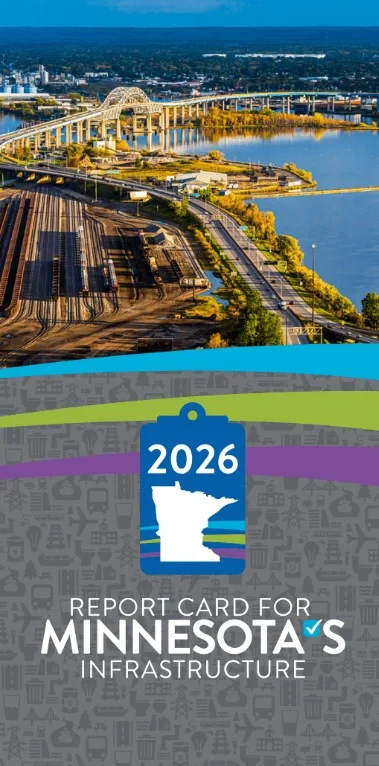
2026 Minnesota Infrastructure Report Card
2026 Report Card GPA: C
Minnesota’s infrastructure forms the backbone of our economy, public health, and daily life. It connects people to jobs and schools, delivers safe drinking water, powers homes and businesses, protects natural resources, and supports recreation and trade. From roads, bridges, transit, and airports to water and wastewater systems, dams, ports, parks, and energy networks, these essential assets enable communities across the state to function, grow, and prosper.
Recent investments demonstrate that sustained funding makes a difference. Strategic spending has helped stabilize conditions in several core systems while advancing modernization and resilience. The historic $2.6 billion bonding bill passed by the 2023 Minnesota Legislature was a clear win for our state’s infrastructure, providing much needed relief for things like wastewater treatment, roads and bridge projects. In the Land of 10,000 Lakes, water infrastructure in particular plays a critical role: protecting public health, supporting industry and agriculture, enabling recreation, and connecting Minnesota to national and global markets. These investments are yielding tangible benefits, strengthening performance, and extending the useful life of key assets.
Despite this progress, significant challenges remain. Much of Minnesota’s infrastructure is aging, with many systems slipping from “good” to “fair” condition—where repair costs escalate and the risk of failure increases. More frequent and intense weather events are accelerating wear and tear, while population growth, economic activity, and new energy demands place added strain on systems designed for a different era. The two bonding bills passed in the last five years, the most recent of which was in the millions of dollars, has not kept up with the billions of dollars in growing project backlog. Without stable funding sources, infrastructure owners face increasing threats to reliability, affordability, and long-term economic competitiveness.
Sustained and strategic investment in preservation, resilience, and modernization is the most cost-effective path forward. Continued progress will require strong public engagement, thoughtful policy, and long-term commitment to funding solutions that prioritize equity and performance. By building on recent successes and addressing emerging risks head-on, Minnesota can ensure its infrastructure continues to support a high quality of life, now and for generations to come.
Click here to read the Minnesota Infrastructure Report Card Executive Summary, and here for the full report.
News & Articles on the 2026 Report Card:
Minnesota maintains 'C' grade in latest ASCE infrastructure report card | KARE 11
Minnesota Keeps C Grade As ASCE Flags $20B Road Shortfall | Hoodline
Minnesota receives ‘C’ grade in 2026 ASCE infrastructure report card | WDIO Duluth
ASCE 2026 Report Card: Minnesota infrastructure at C, roads rated poor | Northern News Now
First Minnesota Report Card release event in 2018
The American Society of Civil Engineers (ASCE) released its 2018 report card on Minnesota's infrastructure at a State Capitol news conference October 9, 2018. Grades were provided in nine categories, including aviation, bridges, dams, drinking water, energy, ports, roads, transit and wastewater.